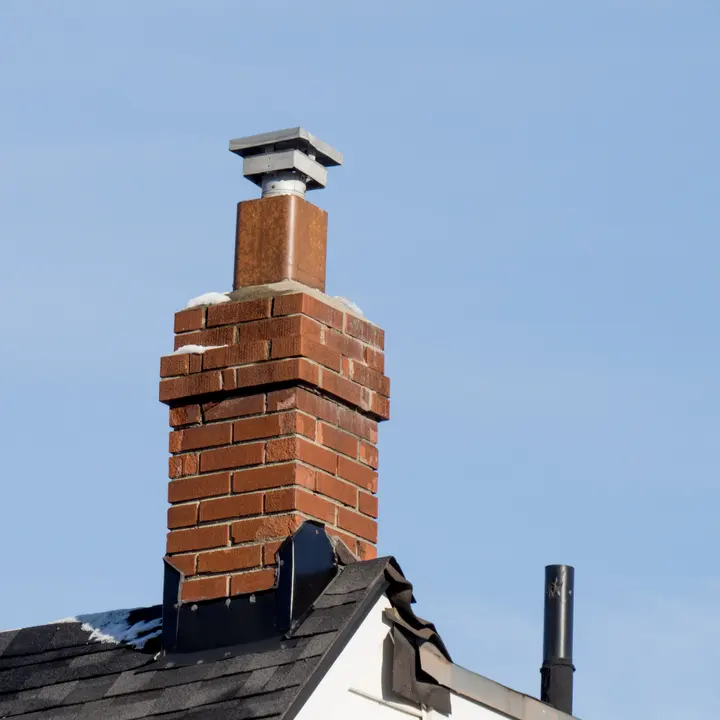
If a roof is going to leak somewhere, it will leak at the chimney. Across the thousands of roofs we have looked at, nothing else comes close. The reason is simple: a chimney is a brick tower pushed up through a surface that is meant to shed water, and the joint between them has to be watertight while the house and the chimney move at different rates for fifty years.
How chimney flashing is supposed to work
There are two layers, and the two layers are the whole trick.
Step flashing is a series of small bent pieces of metal, one per shingle course, each tucked under a shingle and turned up against the brick. Water running down the roof hits the metal and is carried back out onto the shingle below. Step flashing is fastened to the roof, never to the chimney.
Counter flashing is metal let into a groove cut in the mortar joint, bent down over the step flashing. It is fastened to the chimney, never to the roof. Because the two layers overlap but are not joined, the roof can expand and settle and the chimney can do the same, and the joint between them stays covered.
On the uphill side, a cricket or saddle, a small peaked roof behind the chimney, splits the water running down the slope and sends it around rather than letting it pile up against the brick.
What fails
- Counter flashing that was never let into the mortar. It was surface-mounted and caulked, and the caulk has long since opened. This is the most common thing we find.
- Mortar joints that have crumbled, so the counter flashing has nothing to sit in.
- No cricket behind a wide chimney, so leaves and water collect against the back wall until it leaks.
- Rusted or lifted step flashing, or step flashing replaced with one long piece that cannot follow the courses.
- A cracked crown on top of the chimney, which lets water down inside the brick and out through the flashing from behind, a leak that looks like a roof leak and is not.
Why caulk is not a repair
A bead of sealant over the flashing stops a leak for a season. It cannot move with the house, it cannot survive the sun, and it hides the problem while the deck behind it stays wet. We see roofs with four generations of caulk on the chimney and a rotted deck underneath. Flashing is a mechanical joint; it is repaired by rebuilding it, not by gluing it.
What a proper repair looks like
We strip the shingles back from the chimney, replace the step flashing course by course, cut new reglets into the mortar for new counter flashing, repoint the joints that need it, add a cricket if the chimney is wide enough to want one, and relay the shingles with ice and water barrier underneath. If the crown is cracked we tell you, because a new flashing under a leaking crown will not keep the house dry.
The signs to look for
A stain on the ceiling near the chimney, often a few feet downhill of it. Damp or dark wood in the attic beside the chimney. Rust streaks on the flashing. Loose or missing mortar. Water in the firebox after a rain. Any of these is worth a look, and the look is free.