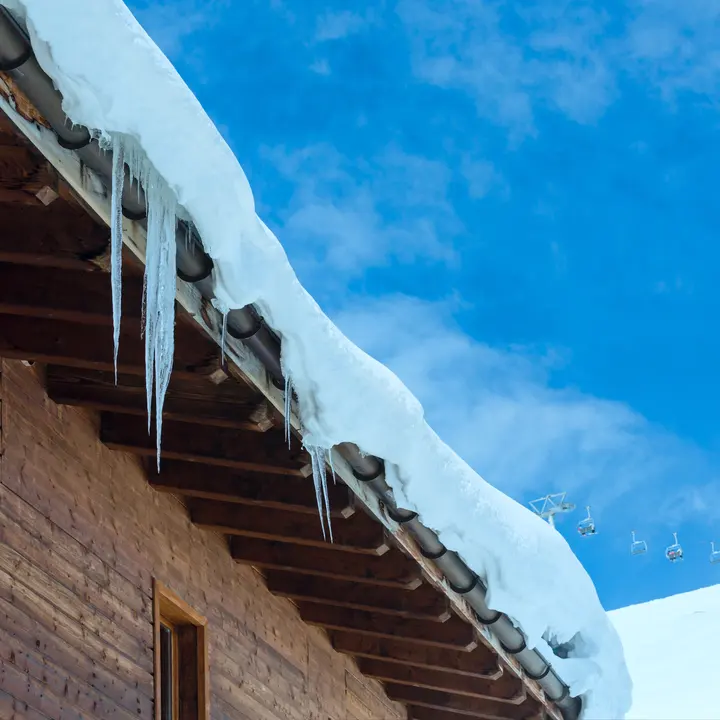
Every February the calls come in the same shape: there is water running down the inside of a wall, the roof is fine everywhere else, and there is a thick ridge of ice along the gutter line outside. That is an ice dam, and it is one of the few roof problems that is caused by the house rather than the roof.
How an ice dam forms
Heat escapes from the living space into the attic. The attic warms the underside of the roof deck. Snow on the upper roof melts from below and runs down the slope as water. When it reaches the eave, which hangs out past the warm walls and stays cold, it freezes again. Each cycle adds a layer, and over a few cold days a ridge of ice builds along the edge of the roof.
Water keeps coming down behind it, and now it has nowhere to go. It pools against the dam, rises, and backs up under the shingles. Shingles shed water running downhill; they do nothing against water sitting still or moving uphill. Once it is under the shingles it finds the nail holes and the deck seams, and from there the insulation, the ceiling and the wall.
Why Long Island gets them
Our winters hover around freezing rather than sitting well below it, which is the perfect condition: enough snow to melt, cold enough at the eave to refreeze, and a thaw every few days to keep the cycle going. Older houses with little attic insulation and no soffit ventilation are the usual victims, but a new roof on a badly vented attic will do it too.
What to do when one is leaking
- Do not chip at the ice with a hammer or an ice pick. You will break the shingles under it and the roof will leak in April as well.
- A roof rake, used from the ground, pulls the snow off the lower few feet of roof and removes the supply of meltwater. This is the single most useful thing a homeowner can do.
- If water is actively coming in, a channel through the dam lets it drain. Calcium chloride in a stocking laid across the dam will melt one; rock salt will stain the roof and kill the plants below.
- Call for a look once it thaws. We need to see what the water did under the shingles.
The real fix is not on the roof
An ice dam is a symptom of a warm roof deck, and the cure is keeping the deck cold: enough insulation on the attic floor to keep the heat in the house, and enough ventilation at the soffits and the ridge to carry away what gets through. Seal the attic hatch, the recessed lights and the bath fan ducts, which are the usual leaks of warm air. Get this right and the snow stays snow until it slides off.
What a roof can do to help
When we replace a roof we install an ice and water barrier along the eaves, a self-sealing membrane under the shingles that runs from the edge up past the warm wall line. It does not stop a dam forming, but it stops the water that backs up behind one from reaching the deck. It is standard on every roof we do on Long Island, and it is the reason a well-built roof can survive a bad winter that would flood an older one.
If you had a dam this winter, the time to look at it is now, while the damage is fresh and before the next one. The inspection is free.