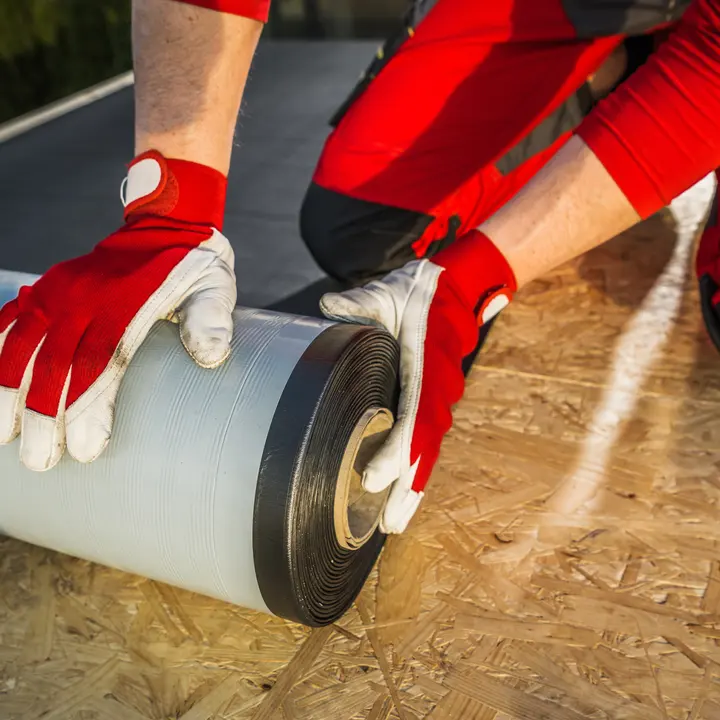
Most flat and low-slope roofs on Long Island, from a back extension on a Cape to a strip of stores on Long Beach Road, are covered with one of two single-ply membranes: TPO or EPDM. Both work. They are installed differently, they fail differently, and each is the better choice in different places. Here is the plain version.
EPDM: the black rubber roof
EPDM is a synthetic rubber sheet, almost always black, that has been on flat roofs since the 1960s. It comes in large sheets, which means fewer seams, and it is glued down or held with ballast. The seams are joined with tape and primer. It stays flexible in the cold, it tolerates the freeze and thaw cycle well, and a tear is easy to patch. Its weaknesses are the heat it absorbs in summer, which warms the building below, and seams that depend on how carefully the adhesive was applied.
TPO: the white welded roof
TPO is a thermoplastic sheet, usually white, whose seams are welded with hot air rather than glued. A properly welded seam is as strong as the sheet itself, which is TPO's great advantage. The white surface reflects the summer sun, which keeps the roof and the rooms under it cooler and is why it has taken over on commercial buildings. It is a younger product than EPDM and its formulation has changed over the years, so the quality of the brand matters more.
Where each one wins
- A roof you can see from upstairs windows or one over living space: TPO's white surface runs cooler and looks cleaner.
- A roof with a lot of units, vents and penetrations: TPO, because every detail is welded rather than glued.
- A simple rectangle with nothing on it: EPDM in one big sheet is hard to beat for value and simplicity.
- A shaded roof or one that collects leaves: the dark EPDM hides what the white TPO shows.
- A repair on an existing roof: match what is there. A patch has to bond to the old material.
Hot and cold applied systems
The older alternatives still have their place. A built-up or modified bitumen roof, applied hot or with cold adhesives, is heavier and more labor to install, but it is tough underfoot and well suited to a roof that gets walked on. We install these where the building calls for them.
The membrane matters less than the rest
Most flat roofs do not fail because the sheet wore out. They fail at the seams, at the drains, at the edge metal and at the places where the roof meets a wall. They fail because water stands in a low spot for days. The slope under the membrane, the tapered insulation that sends water to the drain, the flashing at every edge: that is where a flat roof is won or lost, whichever membrane is on top.
Signs a flat roof needs attention
Water standing more than two days after rain. Blisters and bubbles. Seams lifting at the edges. Cracks around the drains. A ceiling stain under a rooftop unit. Any of these is worth a look before it becomes a replacement; many are repairable for years.
We work on flat roofs for homes, stores, restaurants and public buildings across Long Island, and the estimate is free.